11 Must-Have Ingredients in a Healthy Dog Food Recipe

Flip over almost any bag of dog food and the ingredient list reads like a chemistry exam you didn't study for. Hydrolyzed this. Digest of that. "Animal protein" somewhere in the middle, with no further explanation.
Here's the thing: a genuinely good recipe is identifiable on the label, once you know what you're looking for. The signals are specific, readable, and usually few in number.
These are the 11 ingredients worth finding.
At a glance: named animal protein · egg · salmon oil or fish oil · algal oil · pumpkin · sweet potato · antioxidant-rich vegetables · chicory root, inulin, or FOS · documented probiotic strains · goat's milk · mixed tocopherols
Start Here: Protein Is Everything
Whatever's listed first makes up the bulk of what's actually in the bowl. So, the most important question on any label is also the simplest: is the first ingredient a named protein?
#1: Named Animal Protein: Chicken, turkey, beef, salmon, lamb. A real, specific source: not "poultry," not "meat meal," not "animal protein." The naming matters because it signals traceability. A manufacturer willing to put a specific protein on the label is making a commitment to what's actually in the bag. Vague terms like "animal digest" exist to give manufacturers flexibility in what goes into each batch. That flexibility serves cost control, not your pup.
#2: Egg: Egg holds the benchmark position for protein quality in nutrition research, and it's essentially the reference standard for digestibility and biological value. Named fish and poultry sources rank closely behind, but whole egg on a label is a clear signal of a recipe built around nutrition first. It's also a whole food, not a processed concentrate, which matters when you're looking for clean, recognizable ingredients in your pup's bowl.
What Should the Fat Source Be in Quality Dog Food?
Not all fats are doing the same job. Generic "vegetable oil" adds calories, sure. But very little of what actually helps your dog feel and look their best.
#3: Salmon Oil or Fish Oil: These deliver EPA and DHA (the long-chain omega-3s linked to reduced inflammation, joint health, cognitive function, and yes, that shiny coat everyone talks about). DHA is especially important during puppyhood for brain development, and worth maintaining into senior years when cognitive decline becomes a real concern. If a recipe is thinking beyond basic fat content, it'll name its omega-3 source clearly.
#4: Algal Oil: For recipes that don't feature fish as a primary protein, algal oil is the cleanest plant-based source of DHA available. It means someone actually thought about the full nutritional picture. Not just the primary protein.
Whole Foods You Can Actually Recognize
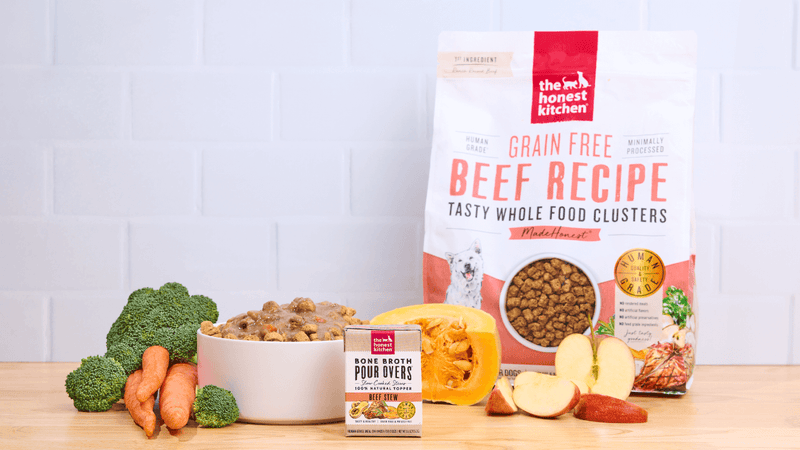
The best recipes include vegetables and fiber sources you'd find in your own kitchen. These aren't filler. They provide micronutrients, antioxidants, and gut-supporting fiber that shape your dog's digestion and immune response.
#5: Pumpkin: A standout ingredient. Pumpkin delivers both soluble and insoluble fiber and is well-documented for supporting stool quality in either direction (constipation or loose stools). If you see it on a label, it's doing real work.
#6: Sweet Potato: A whole food carbohydrate that provides sustained energy, beta-carotene, and additional fiber. Unlike refined starches, sweet potato releases energy steadily. It belongs in the recipe for a reason, not as an afterthought.
#7: Antioxidant-Rich Vegetables (spinach, kale, broccoli): These contribute antioxidants, vitamins, and minerals that support immune function. Specific names matter here. If you see "vegetable pomace" or "plant fiber" with no further detail, that tells you nothing about what's actually in there. Transparency starts with specificity.
What Do Prebiotics and Probiotics Actually Do for Dogs?
#8: Chicory Root, Inulin, or FOS: These are prebiotics, plant-based fibers that pass through digestion unbroken, feeding the beneficial bacteria already living in your dog's gut. Think of probiotics as the good bacteria, and prebiotics as what keeps them fed and thriving. Seeing both on a label together signals a recipe that was designed with the full picture in mind, not just the protein and fat numbers.
#9: Documented Probiotic Strains: Probiotics aren't interchangeable. Look for strains with documented canine research behind them, because benefits are strain-specific. Not species-wide. Worth knowing: probiotics degrade at high heat, so how a food is made matters just as much as what's in it.
#10: Goat's Milk Raw or gently dried goat's milk is one of the most bioavailable whole food sources of probiotics, digestive enzymes, and natural electrolytes out there. It's easier on sensitive tummies than cow's milk, lower in lactose, with smaller fat globules that make it naturally gentler to digest. It supports the gut microbiome in a way that synthetic additives simply can't replicate.
The Preservation Signal
#11: Mixed Tocopherols This is how a quality recipe preserves itself. Naturally. Mixed tocopherols, rosemary extract, and ascorbic acid do the same job as artificial preservatives without the concerns that come with BHA, BHT, ethoxyquin, and propyl gallate.
Once you've worked through the ingredient list, flip to the nutrition panel. Two more things worth checking.
What Does the AAFCO Statement on a Dog Food Label Mean?
Every complete dog food should carry an AAFCO (Association of American Feed Control Officials) nutritional adequacy statement, which means the recipe was evaluated against a defined nutritional standard for a specific life stage. Does it say "Complete & Balanced?" Does the life stage match your dog's? And was it verified through a feeding trial, or just the math?
A feeding trial is the stronger standard. It means real dogs ate the food and the results were measured. Not just that the numbers added up on paper.
What Does Human Grade, Complete and Balanced Actually Mean?
Here's the clearest thing on any label: human grade is a legal standard, not a marketing claim. It means every ingredient comes from the human food supply chain and the food is made in an FDA-regulated facility, the same standard as your grocery store. Your pets won’t believe they’re getting food good enough for people!
Complete and balanced means the recipe meets AAFCO nutritional requirements for your dog's life stage, covering everything they need on the day-to-day.
Those two things together are what actually matter. Human grade tells you what went in and how it was made. Complete and balanced means your pup is covered nutritionally. Better ingredients, crafted thoughtfully.
Since 2002, The Honest Kitchen has had this down. It started with our founder Lucy Postins and her mission to help her Rhodesian Ridgeback, Mosi, through chronic ear infections with a better approach to food. What worked for Mosi became a mission: put pets on the path to good health, through good food. It's why we're vet recommended, B Corp certified, and still at it.
Finding the Right Recipe for Your Pup
Even the cleanest label needs to match the dog eating it. Puppies need higher DHA and more caloric density. Seniors benefit from recipes that support joints and cognitive function. Dogs with sensitive tummies do best on a limited ingredient recipe built around a single named protein, and a shorter list makes it easier to spot what's working.
Not sure where to start? Our product quiz matches your pup's age, size, and health profile to the right recipe in about two minutes.
The label tells the whole story, if you know how to read it. You've got this.
Frequently Asked Questions
What are the 11 ingredients to look for on a dog food label?
Named animal protein, egg, salmon oil or fish oil, algal oil, pumpkin, sweet potato, antioxidant-rich vegetables (like spinach, kale, or broccoli), chicory root or inulin or FOS, documented probiotic strains, goat's milk, and mixed tocopherols. Together, these signal a recipe built around real nutrition. Not just cost efficiency.
What does "human grade" mean on a dog food label?
It means every ingredient comes from the human food supply chain and the food is manufactured in a facility that meets FDA human food production standards, the same oversight that applies to food you buy at a grocery store. It's a meaningfully higher bar than "feed grade," which allows ingredients and manufacturing conditions not permitted in human food. Complete and balanced means the recipe meets AAFCO nutritional requirements for your dog's life stage, so your pup is covered on both fronts.
What's the difference between prebiotics and probiotics in dog food?
Probiotics are live beneficial bacteria. Prebiotics are the plant-based fibers (like inulin and FOS) that feed and sustain those bacteria once they're in the gut. A food with probiotics but no prebiotics is like stocking a pantry and never restocking it. Ingredients like chicory root, goat's milk, and documented probiotic strains work together as a system, not in isolation.
What's the difference between "feeding trial verified" and "formulated to meet" on a dog food label?
Both are valid AAFCO nutritional adequacy claims, but they're not equal. "Formulated to meet" means the recipe was calculated on paper to hit the right nutrient targets. "Feeding trial verified" means real dogs ate the food over time and the results were measured. The feeding trial is the higher bar. It's the difference between a recipe that looks right in theory and one that's been proven to work in practice.