What Kind of Dog Food Is Best for Your Dog's Health?

The healthiest dog food is made from whole, recognizable ingredients, made in a way that keeps their nutrition intact, and held to the same safety standards as human food.
It's one of the first questions any pet parent asks, and one of the hardest to answer once you're standing in a pet food aisle packed shoulder to shoulder with bags all shouting for attention. Every bag makes some version of the same claim. "Premium." "Natural." "Complete and balanced." The language is everywhere. The clarity isn't.
Here's what those terms actually mean, and how to see through the noise.
How Does the Way Dog Food Is Made Affect Its Nutrition?
The healthiest dog food isn't just about what's in it. It's about what survives the process.
Before we get to ingredients and reading labels, it's good to understand that how a food is made determines how much nutrition actually reaches your dog's bowl. Here's the issue with most kibble: it's produced through high-heat extrusion, ingredients cooked at extreme heat and pressure until they're pushed out as uniform little pebbles. That heat degrades heat-sensitive vitamins and reduces the bioavailability of key amino acids like lysine, which dogs need for muscle repair, immune function, and calcium absorption. Dogs can't produce lysine on their own. What's in the bowl delivers it.
Gentler methods (low-temperature dehydration in particular) remove moisture without damaging the nutrition that whole ingredients bring to the recipe. The nutrients that went in are largely still there when it hits the bowl. Fresh without the fridge.
What Does "Complete and Balanced" Mean on a Dog Food Label?
Every dog food carrying an AAFCO "complete and balanced" statement meets a minimum nutrient threshold for daily feeding, and that's worth something real: it means the food covers your dog's basic needs. But it's a floor, not a ceiling.
What it doesn't tell you: anything about ingredient quality, sourcing, or how much of what's on the label your dog can actually absorb. A food can check the box and still be built on ingredients you'd never recognize as your food.
When you're reading the AAFCO statement, look for two things:
Life stage match. Does the food match your dog's actual life stage? Puppies need more calcium, protein, and fat to support growth. "All life stages" foods meet that higher puppy bar, which can mean some adult dogs get more than they need.
Feeding trial vs. formulation. Both are technically AAFCO compliant. They're not the same thing. A feeding trial means real dogs ate the food and were monitored over time. Formulation means the nutrient math checks out on paper, with no dog involved. Worth knowing which one you're looking at.
What Makes Human Grade Dog Food Different from Premium Dog Food?
Most commercial pet food, even the well-marketed, premium-positioned stuff, is made from feed grade ingredients. Feed grade is a supply chain with significantly lower safety and quality standards than what goes into your own groceries. Ingredients that don't make the cut for human consumption are fully accepted in feed grade pet food.
Human grade is a federally defined standard. To carry a legitimate human grade claim, every ingredient and the finished product must be stored, handled, prepared, and transported in compliance with federal human food laws, the same standard your own groceries operate under. Not a looser set of rules written for pet food. The same rules.
That distinction changes what goes into the bag. Human grade ingredients come from the human food supply chain: chicken breast, sweet potato, whole egg. The whole food, not the remnants. When every ingredient is something you'd recognize at the grocery store, that's not clever marketing. That's what human grade makes possible.
One flag worth knowing: "made with human grade ingredients" is different from "human grade." It's a marketing phrase, not a regulated claim. It says something about ingredients but communicates nothing about how the food was made. A finished product can use some human grade ingredients and still be made in a feed grade facility. The only claim that means anything is that the entire finished product is human grade.
How Do You Read a Dog Food Label?
Once you know what you're looking for, the label starts to tell a story.
Named proteins at the top. Chicken, turkey, beef, salmon: specific, real names. "Animal protein" or "meat meal" without a named species is worth a raised eyebrow.
A life stage match. The AAFCO statement should match your dog's actual life stage.
Short, recognizable ingredients. If you couldn't find them at a grocery store, that's worth noting.
A human grade claim. One that covers the whole product.That's the one that counts.
The Honest Kitchen: Built Around the Healthiest Standard
In 2002, Lucy Postins was in her San Diego kitchen watching her Rhodesian Ridgeback, Mosi, struggle with chronic ear infections. When she changed what he ate, she noticed a big difference. Trying to find an easier option than constant presence in the kitchen, she experimented with gently dehydrating whole foods—preserving their nutrients while making mealtime easier. That was the beginning of The Honest Kitchen, and the standard she set then hasn't budged since.
Our human grade recipes are made with whole ingredients from the human food supply chain and produced in a human food facility under FDA oversight, developed alongside board-certified veterinary nutritionists and PhD food scientists. THK is vet recommended, B Corp certified, made in the USA, and has been the world's first human grade pet food brand.
The results speak for themselves. In a survey of THK customers, 80% reported improved digestion after switching, 77% reported improved energy, and 71% saw better skin and coat. That's what pet parents tell us, consistently.
What's the Right Food for My Dog Specifically?
The healthiest food is also the right food for your individual dog. A puppy tearing through the house has different needs than a ten-year-old who's earned his spot on the couch. A pup with a sensitive tummy may need a single protein source rather than a blend. Size, life stage, and activity level all matter.
Wholemade Dehydrated Recipes: Whole ingredients, low-temperature dehydrated, just add warm water. A 10 oz box produces 40 oz of food once rehydrated. Available across proteins and life stages.
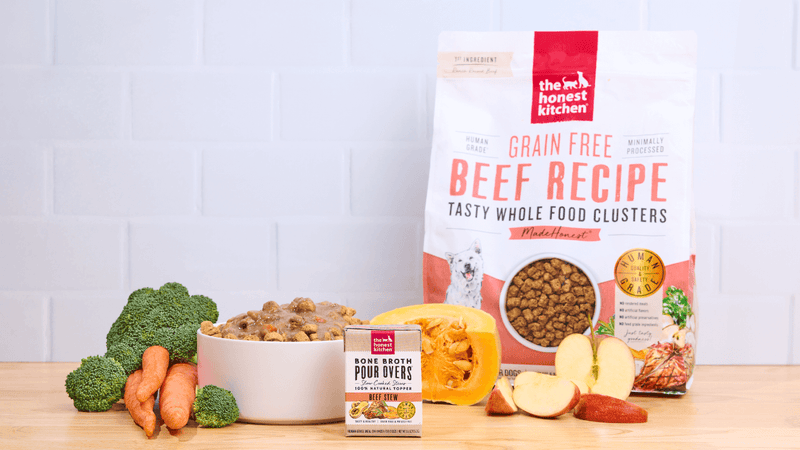
Whole Food Clusters: See and smell the real food ingredients in every golden, roasted bite of our clusters. Human grade dry food in whole grain and grain free options, across sizes and life stages.
Check out our Essential Clusters to make serving human grade nutrition simple. Crafted with thoughtfully sourced protein and essential nutrients, this minimally processed dry food delivers the high-quality nutrition your pup needs to thrive. And if you are looking for a dry food that packs a protein punch, check out our Protein Plus Clusters.
Wet Food & Toppers: For variety, targeted nutrition, or the pup who needs a little convincing. Our wet foods are complete and balanced human grade meals in their own right. Toppers are the delicious extra: flavor boosts, targeted support, and a little help for picky eaters.
Supplements & Broths: Our shelf stable hydration boosters and best-selling digestive supplement make boosting health and wellness in your dog’s meal routine easy.
The right food isn't one-size-fits-all, and you don't have to figure it out alone. Take our product quiz, and we'll point you toward the recipes that fit your pup best.
Key Takeaways
The healthiest dog food is made from whole, recognizable ingredients, gently processed, and held to human food safety standards.
"Complete and balanced" sets a nutrient floor, not a quality ceiling.
"Human grade" is a regulated standard; while "made with human grade ingredients" does not carry the same weight.
Check labels for named proteins, life stage match, and a human grade claim covering the entire product, not just the ingredients.
The best food for your dog depends on their size, life stage, and any sensitivities, not just the label.
Frequently Asked Questions
Is human grade dog food actually better for dogs?
Human grade food is held to stricter ingredient and manufacturing standards than conventional pet food. That means higher quality inputs, safer production, and ingredients with greater nutritional integrity. It's not a marketing distinction. It's a federally defined one.
Is kibble bad for dogs?
Not inherently, but the way most kibble is made does affect its nutritional value. High-heat extrusion can degrade heat-sensitive vitamins and reduce the bioavailability of key amino acids. A dog can do fine on conventional kibble, but food made from whole ingredients with less heat tends to support better digestion, energy, and coat health over time.
What does "complete and balanced" mean on a dog food label?
It means the food meets AAFCO's minimum nutrient requirements for daily feeding. That's a meaningful baseline, but it says nothing about ingredient quality or how bioavailable those nutrients actually are. Think of it as the starting point, not the finish line.
How do I know if a dog food is truly human grade?
Look for a claim that covers the entire finished product, not just the ingredients. "Made with human grade ingredients" is a marketing phrase with no regulatory weight. A legitimate human grade product is manufactured in a certified human food facility and can be verified with documentation. If a brand can't answer basic questions about where and how their food is made, that tells you something.
What is the healthiest type of dog food?
While it may vary depending on your dog's needs, our healthy food combines whole, recognizable ingredients with a gentle cooking method that preserves their nutrition, and is held to human food safety standards from start to finish. Gently made options like human grade dehydrated food tend to deliver ingredient quality, nutrient preservation, and digestibility.